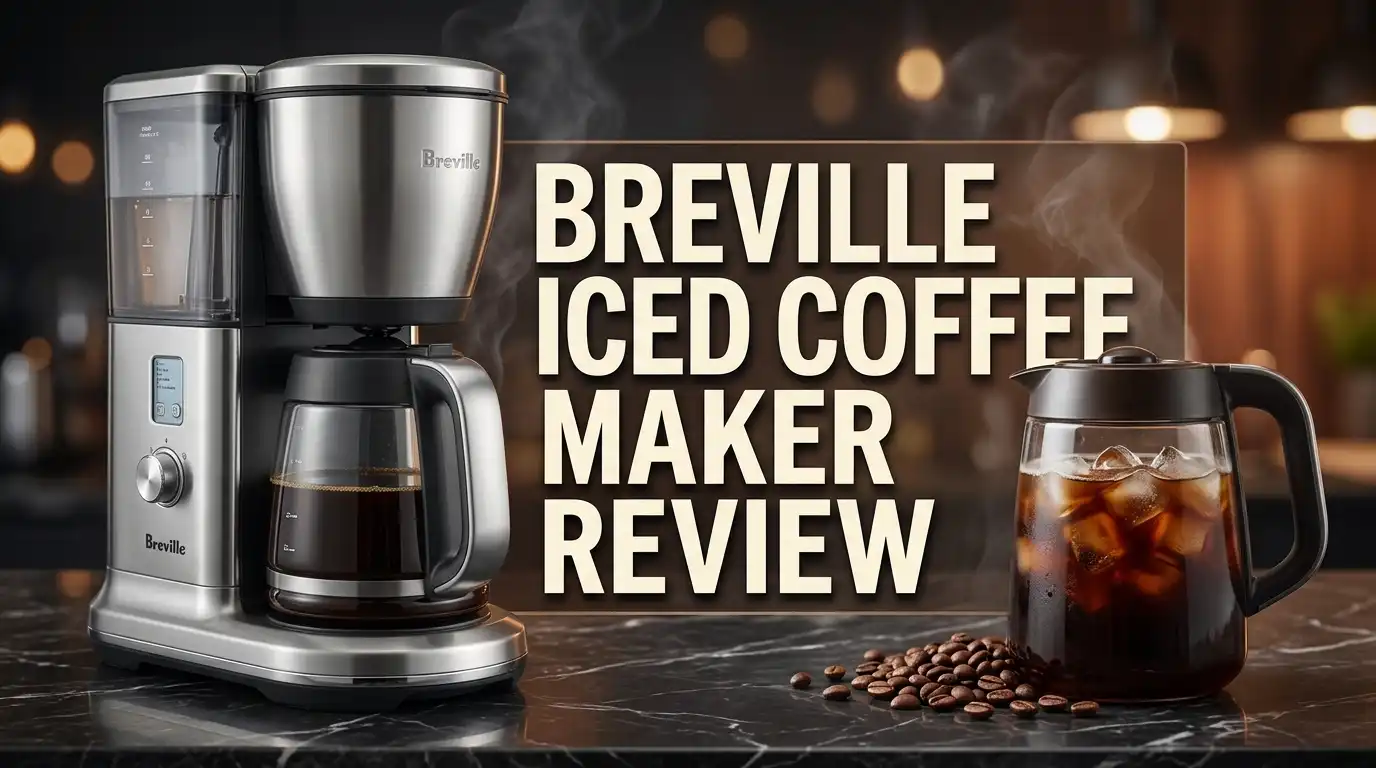
Breville Iced Coffee Maker Review 2026: Worth Your Money?
Iced coffee at a cafe costs about six dollars. Brew it at home and the same glass costs under sixty cents.
That math is why so many people search for a Breville iced coffee maker each summer. Breville does not sell a machine called “the Iced Coffee Maker” in the United States, and that confuses a lot of shoppers.
What Breville actually sells is better. Two drip machines with dedicated iced and cold brew presets handle the job, and they do it with real temperature control instead of guesswork.
I spent weeks pulling shots of iced coffee from both. The results surprised me in a few places. This review covers what works, what annoys, and whether the price makes sense in 2026.
Key Takeaways
- Breville sells iced coffee through drip machines, not a standalone iced brewer. The Precision Brewer and the newer Luxe Brewer both include presets for chilled drinks.
- The Precision Brewer BDC450BSS remains the flavor champion. Its Over Ice mode brews stronger and hotter, then you pour that concentrate straight onto ice. Six modes total, adjustable temperature between 197F and 204F, and a 60 fl oz thermal carafe.
- The Luxe Brewer BDC465BSS wins on speed and convenience. Its cold brew preset finishes in about 30 minutes instead of 14 hours. It also adds a fully removable water tank, which the Precision Brewer never had.
- Expect to pay between $290 and $400 depending on model and sale timing. That is real money for iced coffee, so the value only makes sense if you drink coffee daily and want hot brewing too.
- Both machines carry SCA Golden Cup credentials and share the same accessory kit. You get a cone insert, a flat bottom basket, a mesh filter, and a water hardness strip in the box.
Why Breville Handles Iced Coffee Differently
Most iced coffee machines take one shortcut. They brew normal strength coffee and dump it over ice. The ice melts, the coffee thins out, and you drink brown water.
Breville attacks the problem at the extraction stage instead. The Over Ice preset raises the brew strength before the water ever touches your cup.
The machine does this by slowing the flow rate and holding water against the grounds longer. More soluble material moves from the bean into the liquid. You end up with a concentrate that survives dilution.
Breville also recommends doubling your coffee dose for this mode. That advice sits in the manual and it matters. Skip it and your drink tastes flat.
Temperature control adds the second layer. Both machines let you dial water between 197F and 204F, and that range covers almost every roast profile you will meet.
Light roasts want the top of that range. Dark roasts want the bottom. Iced drinks made from light roasts especially benefit, because chilling mutes acidity and you need every bit of brightness you can extract.
The third piece is the showerhead. Water sprays across the whole bed of grounds instead of drilling one hole through the middle.
Even saturation means even extraction. Uneven extraction produces sour and bitter notes in the same cup, and cold makes those flaws easier to taste.
This is the honest reason a Breville costs more than a $90 iced coffee machine. You pay for control over three variables that actually change flavor.
Breville Precision Brewer Thermal BDC450BSS Review

Last update on 2026-07-16 / Affiliate links / Images from Amazon Product Advertising API
The BDC450BSS earned its reputation the hard way. It landed on the Specialty Coffee Association certified list, and reviewers have recommended it for years.
Six brew modes cover almost every scenario. You get Gold, Fast, Strong, Over Ice, Cold Brew, and My Brew.
Gold follows SCA parameters automatically. Fast cuts a full pot down to roughly three or four minutes instead of six to eight.
Over Ice is the mode you came for. It brews up to 20 ounces at higher strength, and Breville suggests chilling the result for two hours before serving if you want the cleanest taste.
Cold Brew handles the slow route. Steep time runs up to 14 hours by default and stretches to 24 hours for a heavier concentrate, with the same 20 ounce ceiling.
My Brew is the setting enthusiasts love. You adjust bloom time, bloom volume, flow rate, and temperature, then save the profile.
Build quality is where this machine quietly wins. The double wall stainless carafe feels dense, and owners report coffee staying warm across several hours.
The footprint measures roughly 12.7 by 6.7 by 15.7 inches. That fits under most cabinets without drama.
The main complaint is the fixed water reservoir. You fill it with the carafe or a pitcher, and it never gets easy.
Breville has marked this model discontinued on its own site, though Amazon stock continues to move. Prices bounce around $340 for new units and dip lower for used listings.
Breville Luxe Brewer Thermal BDC465BSS Review


Last update on 2026-08-01 / Affiliate links / Images from Amazon Product Advertising API
The Luxe Brewer is the newer machine, and Breville built it around one idea. Fewer buttons, faster results.
You press Brew and the machine handles the rest. It targets SCA Golden Cup standards without asking you to think about anything.
The headline feature for iced coffee drinkers is speed. The cold brew preset finishes in up to 30 minutes depending on water volume.
Read that again. Thirty minutes versus fourteen hours is a genuine change in how you use a coffee machine.
Breville achieves this with a higher concentration brew designed as a base. You pour it over ice, cut it with milk, or use it in cocktails.
Custom Brew handles the deep control. You fine tune bloom volume, bloom time, brew temperature, and flow rate, and the machine remembers your profile for next time.
The removable 60 fl oz water tank fixes the Precision Brewer’s biggest flaw. It lifts out, the lid opens wide, and filling it takes seconds.
A Claro Swiss water filter sits inside the tank. Better water means better coffee and less scale buildup.
The thermal carafe holds coffee above 150F for up to four hours. Delayed start runs 24 hours ahead.
Dimensions come in at 16.1 by 10.2 by 6.8 inches, so it sits wider and shorter than the Precision Brewer.
Price sits around $349.95 new on Amazon at the time of writing. Used listings have appeared near $241.
One note: the Luxe Brewer drops the separate Over Ice preset. You use Cold Brew instead, which changes the workflow but reaches a similar destination.
How the Over Ice Mode Works Step by Step
Getting good iced coffee from a Breville takes about four minutes of active work. Here is the routine that produced my best results.
Start with double the coffee you normally use. If your usual 20 ounce pot takes 40 grams, weigh out 80 grams.
Grind medium fine. Slightly finer than your hot drip setting helps, because the extra surface area builds strength faster.
Fill your glass or carafe with ice first. Do this before brewing, not after.
Hot coffee hitting cold ice immediately is called flash chilling, and it locks in aromatics that would otherwise escape as steam.
Select Over Ice on the Precision Brewer, or Cold Brew on the Luxe Brewer. Set your water volume at 20 ounces or less.
Let the machine run. It brews slower than the Fast setting on purpose.
Pour the finished concentrate straight over the ice. The ice will melt fast and that is the point.
Stir for ten seconds before you taste. Uneven dilution makes the top of the glass taste different from the bottom.
If you want the smoothest possible drink, follow Breville’s advice and refrigerate the brewed concentrate for two hours first. Then pour over fresh ice.
That second method costs patience but delivers a cleaner cup. I preferred the flash chill version for weekday mornings and the refrigerated version for weekends.
Add milk last. Dairy and oat milk both dull the acidity, so taste the coffee black first to judge your recipe.
Top 3 Alternative for Breville Precision Brewer Thermal

Last update on 2026-08-01 / Affiliate links / Images from Amazon Product Advertising API

Last update on 2026-08-01 / Affiliate links / Images from Amazon Product Advertising API

Last update on 2026-09-17 / Affiliate links / Images from Amazon Product Advertising API
Cold Brew Mode Compared With Over Ice Mode
These two modes confuse buyers constantly. They produce different drinks and they are not interchangeable.
Over Ice brews with hot water and chills afterward. Cold Brew steeps grounds in cool water for hours.
Hot extraction pulls out acids, aromatics, and oils quickly. Your drink tastes bright, complex, and closer to the roaster’s intent.
Cold extraction leaves most acid behind. The result tastes rounder, sweeter, and heavier in body.
Neither is better. They serve different moods.
Over Ice takes minutes. Cold Brew on the Precision Brewer takes up to 14 hours, though the Luxe Brewer cuts that to roughly 30 minutes.
Caffeine content differs too. Cold brew concentrate usually carries more caffeine per ounce because of the higher dose and longer contact time.
Acidity is the practical dividing line. If coffee upsets your stomach, cold brew is the kinder choice.
If you love fruity Ethiopian beans and want to taste blueberry notes, use Over Ice. Cold extraction flattens those flavors.
Both modes cap at 20 ounces on the Precision Brewer. That limit frustrates people brewing for a household.
My workaround is simple. I brew a 20 ounce batch of cold brew concentrate every other evening and keep it in a sealed jar.
It stays good for about a week in the fridge. One jar covers roughly six iced drinks once diluted.
For guests, I use Over Ice and brew fresh. It looks better and tastes livelier.
Build Quality, Size, and Carafe Choice
Breville machines feel expensive because they are built from real materials. Brushed stainless dominates both models, with plastic reserved for internal parts.
The Precision Brewer felt more solid than every competitor in independent testing, including the Technivorm Moccamaster.
Its double wall stainless carafe is thick and heavy. Drop it and the floor loses.
The Luxe Brewer uses similar construction with a slightly different silhouette. It sits lower and wider.
Now the carafe decision. Both machines come in thermal and glass versions.
Glass models place coffee on a warming plate. That keeps it hot but can cook the flavor over an hour or two.
Thermal carafes use insulation instead of heat. Coffee stays warm without stewing.
For iced coffee specifically, the carafe barely matters. You are pouring the brew over ice anyway.
If you also drink hot coffee across the morning, thermal wins. The BDC450BSS holds temperature well past the two hour mark according to owners.
Glass versions cost less. The BDC400BSS and BDC415BSS are the glass equivalents if you want to save money.
Counter space matters more than most people expect. The Precision Brewer stands 15.7 inches tall, and standard cabinets sit 18 inches above the counter.
You have room, but filling the fixed reservoir under a cabinet is awkward. This is exactly why the Luxe Brewer’s removable tank feels like such an upgrade.
Measure your space before ordering either machine.
Setup, Daily Use, and Cleaning
Unboxing takes about ten minutes. Both machines ship with a cone filter basket insert, a flat bottom basket, ten paper filters, a mesh filter, a measuring scoop, and a water hardness test strip.
Run the hardness strip first. It tells the machine how often to remind you about descaling, and it takes thirty seconds.
The Precision Brewer requires a flush cycle before your first brew. Few machines demand this and it catches people off guard.
Controls use two knobs and a small screen. The interface is one of the simplest on any premium brewer.
The Luxe Brewer simplifies further. Press Brew and walk away.
Owners of both machines mention the same learning curve issue. The manual is thorough but dense, and the number of options feels heavy at first.
Give it a week. After that, you will use two or three settings and ignore the rest.
Cleaning is straightforward. Wipe the exterior with a soft cloth, and wash the carafe, lid, and mesh filter in warm soapy water.
Rinse the carafe after every use. Coffee oils build up and turn rancid, and that flavor transfers to iced drinks fast.
Descaling triggers when the light flashes. Use a commercial descaling solution or a 50/50 mix of white vinegar and water.
The process runs about 15 minutes. That is quick compared to machines that need several hours.
The Luxe Brewer’s Claro Swiss water filter needs replacement every few months. Budget for that small ongoing cost.
Taste Test Results and Brew Consistency
I ran the same beans through both machines across two weeks. Medium roast Colombian, light roast Ethiopian, and a dark roast blend.
The Precision Brewer produced the most nuanced iced coffee. Over Ice with the Ethiopian gave clear citrus and stone fruit notes even after dilution.
The dark roast came through as chocolate and caramel with no burnt edge. Temperature control at 199F helped there.
Consistency across batches was excellent. Water temperature held steady, and the showerhead soaked the bed evenly every time.
One weakness showed up in single cup brewing. Brewing into a small mug caused splashing, and I ended up using a taller travel tumbler instead.
The Luxe Brewer’s fast cold brew genuinely impressed me. Thirty minutes produced a concentrate that tasted smooth and sweet, closer to overnight steeping than I expected.
It was not identical to a 14 hour steep. The traditional method still delivered slightly more body and depth.
For a Tuesday morning when I forgot to prep the night before, the difference did not matter.
The Luxe Brewer’s one touch Brew mode nailed hot coffee every time. Its Custom Brew profile let me push flow rate slower for stronger iced drinks.
Grind size mattered more than the machine. A slightly finer grind improved both brewers noticeably for iced modes.
Bean freshness mattered most of all. Beans roasted within three weeks tasted dramatically better than supermarket bags, regardless of which machine brewed them.
Neither machine can rescue stale coffee. That is worth knowing before you spend $350.
Pros and Cons of Breville Iced Coffee Makers
Pros
- Real temperature control between 197F and 204F lets you match brew heat to roast level, which matters more for iced coffee than most people realize.
- Dedicated iced and cold brew presets remove guesswork, and the Over Ice mode brews stronger automatically so melting ice does not ruin your drink.
- Build quality feels premium across both models, with thick stainless carafes and materials that reviewers rated above competing machines.
- Versatility is outstanding. One appliance covers hot drip, iced coffee, cold brew concentrate, single cup brewing, and optional pour over with an adapter.
- Both cone and flat bottom baskets ship in the box, so you can shift flavor profiles between fruity and chocolatey without buying accessories.
- Cleaning and descaling are quick, with the descale cycle finishing in roughly 15 minutes.
Cons
- Price is the biggest barrier. Expect $290 to $400, which is three to seven times what a basic iced coffee machine costs.
- Iced and cold brew modes cap at 20 ounces on the Precision Brewer, which frustrates households brewing for two or more people.
- The Precision Brewer’s water reservoir does not remove, making refills awkward under kitchen cabinets.
- The learning curve is real. The manual overwhelms new owners, and the number of adjustable variables intimidates casual drinkers.
- The pour over adapter costs extra despite documentation implying it is included.
- Single cup brewing splashes when you use a short mug.
- The Precision Brewer shows as discontinued on Breville’s site, which raises long term parts questions.
Price, Value, and Where the Money Goes in 2026
Let me be direct about the money. A Breville is a poor choice if iced coffee is the only thing you want.
The Keurig K Iced does that job for around $110. The OXO cold brew maker does it for under $50.
Breville makes sense when iced coffee is one part of a broader coffee habit. You are buying a hot brewer, a cold brew maker, and an iced coffee machine in one body.
Current Amazon pricing puts the Luxe Brewer Thermal around $349.95. The Precision Brewer Thermal has traded near $340 new, with used units dropping considerably lower.
Price history shows meaningful swings. Both models dip during major sale events, and used listings have hit the low $200s.
Glass carafe versions save you roughly $30 to $50. The BDC400BSS and BDC415BSS give identical brewing with a warming plate instead of insulation.
Run the daily math. Six dollars a day at a cafe reaches $2,190 a year.
A $350 machine pays for itself in about two months if it replaces a daily cafe run. Add beans at roughly $18 a bag and you still land far ahead.
The counterargument is honest too. A $150 Ninja DualBrew Pro also replaces that cafe run and saves you $200 upfront.
You pay the Breville premium for flavor control, build durability, and consistency. Those things are real but they are refinements, not necessities.
Buy accordingly.
Best Beans, Grind, and Ice Tips for Better Iced Coffee
Your machine is only as good as what you feed it. These adjustments improved my iced coffee more than any setting change.
Buy beans roasted within the last three weeks. Check the roast date on the bag, not the expiration date.
Medium roasts work best for beginners. They balance sweetness and acidity, and they forgive mistakes.
Light roasts shine in Over Ice mode. Ethiopian and Kenyan beans deliver fruit notes that survive chilling beautifully.
Dark roasts belong in cold brew. Their chocolate and nutty character rounds out into something close to dessert.
Grind medium fine for iced modes. A notch finer than your hot drip setting adds strength without adding bitterness.
Weigh your coffee. A scale costs $15 and removes the single biggest source of inconsistency.
Start at 1 gram of coffee for every 8 grams of water for iced brewing. That is double the normal drip ratio.
Freeze coffee into ice cubes. Brew a batch, pour it into a tray, and use those cubes instead of water ice.
Your drink never gets weaker as it melts. This trick alone changed my summer routine.
Use filtered water. The Luxe Brewer includes a Claro Swiss filter, and the Precision Brewer benefits from a pitcher filter.
Chill your glass in the freezer for five minutes before pouring. Less ice melts on contact.
Add sweetener as syrup, not granules. Sugar does not dissolve in cold liquid and settles at the bottom.
Simple syrup takes two minutes to make with equal parts sugar and hot water.
Who Should Buy One and Final Verdict
The Breville iced coffee approach fits a specific person. Let me describe them clearly.
You drink coffee every single day, hot and cold. You already buy decent beans and you notice the difference between a good cup and a bad one.
You want one machine on the counter instead of three. You value control and you enjoy adjusting variables.
You have $300 to $400 and you plan to keep the machine for years.
If that sounds like you, buy the Luxe Brewer Thermal BDC465BSS. The 30 minute cold brew and the removable water tank solve the two biggest complaints about the older model.
If you want maximum control and a dedicated Over Ice preset, hunt for the Precision Brewer Thermal BDC450BSS. Its My Brew profile and six modes still outclass most machines on the market.
Skip both if you only want cold coffee. The Keurig K Iced or the OXO cold brew maker will make you happier for far less money.
Skip both if you brew occasionally. These machines reward frequent use and punish neglect with scale buildup.
My verdict after weeks of testing: the Luxe Brewer is the smarter 2026 purchase. Speed and convenience matter more in daily life than an extra preset you will rarely touch.
The Precision Brewer remains the enthusiast’s pick and a strong buy if you find one discounted.
Either way, you get iced coffee that tastes better than the cafe version at a fraction of the cost. That was the whole point.
Frequently Asked Questions
Does Breville make a dedicated iced coffee maker for Amazon.com buyers?
No. Breville in the United States sells iced coffee capability through its drip machines, specifically the Precision Brewer and the Luxe Brewer. A product called “the Iced Coffee Maker” exists in the UK market, but it comes from a different company that shares the Breville name there. Amazon.com shoppers should look at the BDC450BSS or the BDC465BSS instead.
How long does cold brew take on a Breville?
It depends on the model. The Precision Brewer runs a default cycle of up to 14 hours and stretches to 24 hours for stronger concentrate. The Luxe Brewer finishes cold brew in up to 30 minutes depending on water volume, which is the single biggest improvement in the newer machine.
How much coffee should I use for the Over Ice setting?
Use roughly double your normal amount. Breville recommends this directly in the manual because melting ice dilutes the drink. If you normally use 40 grams for a 20 ounce pot, use 80 grams for iced brewing.
Can I brew a full carafe of iced coffee?
Not on the Precision Brewer. Both the Over Ice and Cold Brew settings cap at 20 ounces. You can brew multiple batches back to back, or brew concentrate and store it in the fridge for up to a week.
Is the pour over adapter included with the Precision Brewer?
No, and this trips up many buyers. The adapter kit sells separately on Amazon. It comes bundled only with the pricier BDC455 Brewers Cup Tribute edition sold through Breville’s own website.
Should I choose the thermal or glass carafe version?
For iced coffee, the choice barely matters since you pour over ice anyway. If you also drink hot coffee across a long morning, thermal keeps it warm for up to four hours without a hot plate cooking the flavor. Glass versions cost less and work fine for people who finish a pot quickly.
Is a Breville worth it compared to a Ninja or Keurig?
It depends on your priorities. A Ninja DualBrew Pro costs about $200 less and handles iced coffee well without temperature control or SCA certification. A Keurig K Iced makes a cup in under a minute for around $110. Breville wins on flavor control, build quality, and consistency, but those are refinements rather than necessities.
How often does a Breville need descaling?
Watch for the descale light. Frequency depends on your water hardness, which the included test strip measures during setup. Hard water areas may need descaling every two months, while filtered water can stretch that to six months. The cycle itself takes roughly 15 minutes.

Hello! I’m Eloise Wilson, the culinary enthusiast behind SimplyCookings. Cooking is my canvas and flavors are my palette. I’m here to share easy-to-follow recipes and kitchen wisdom that will make your cooking journey joyful and delicious. Join me and let’s turn everyday meals into extraordinary experiences!